|
|
|
|
Winmate NTDRW100 — A Compact Edge AI Box PC with NVIDIA Jetson Orin Nano
It looks like a Box PC, but it isn't: Understanding a new class of industrial edge AI computers
(by Conrad H. Blickenstorfer, Ph.D.)
At first sight, the Winmate NTDRW100 looks just like a super-compact Box PC — a 5.1 x 2.7 x 5.9 inch black metal enclosure with deep aluminum cooling fins covering its entire top. And a Box PC it is, with the usual assortment of ports, connectors, and power supply.
It is, and it isn't. Because the Winmate NTDRW100 is an "AI DIN Rail Box PC with NVIDIA Jetson Orin Nano."
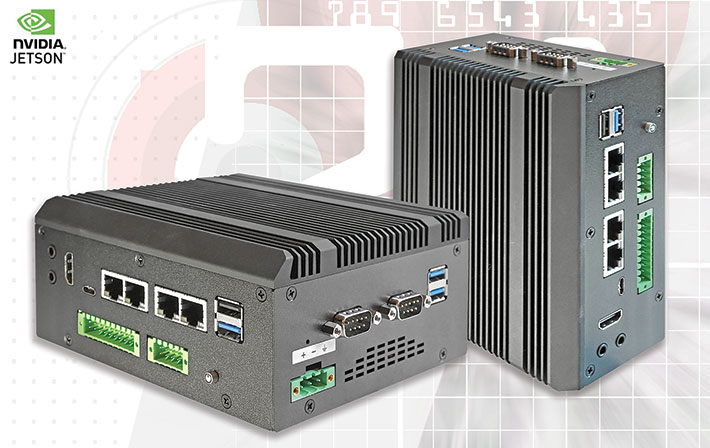
Now what does that mean? First, the NTDRW100 doesn't run Windows — it runs a specialized version of Ubuntu Linux. And it doesn't just perform conventional computing tasks; it is designed for "edge AI computing." In practice, systems like the NTDRW100 are used for applications that require near-instant recognition and response, such as real-time video analytics, object detection, predictive maintenance, and autonomous system control.
Winmate's concept is to package substantial AI processing capability into a compact, rugged Box PC that can be deployed almost anywhere — including locations where reliable cloud connectivity may be limited, intermittent, or unavailable.
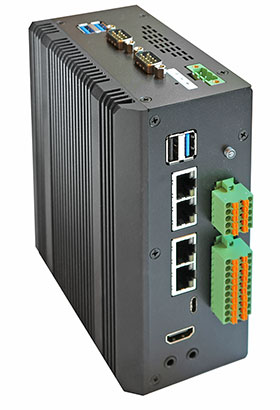
So what does that look like in physical form? Below is a look at the top and all four sides of the Winmate NTDRW100. As you can see, it resembles a typical industrial Box PC, with a compact, rugged metal enclosure housing the electronics. There is no fan; instead, the system relies on extensive heat-dissipating finning.
Winmate calls it a DIN Rail Box PC. DIN rail mounting is a worldwide standardized system used to quickly and securely attach electrical and electronic components inside control cabinets. Note the mounting mechanism attached to the side of the NTDRW100 — it allows the unit to snap directly onto a standard DIN rail.
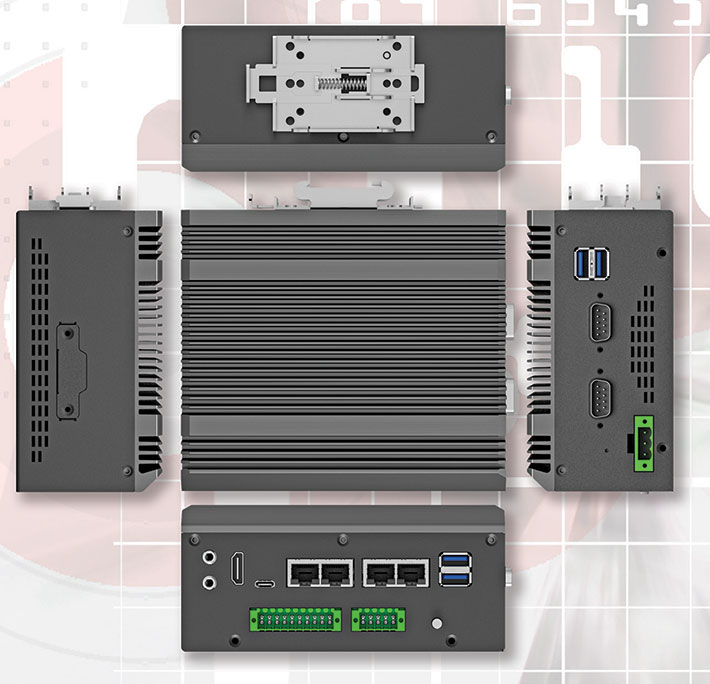
Like all industrial Box PCs, the NTDRW100 offers extensive wired connectivity. There are four Gigabit LAN ports, one of them capable of supplying up to 30 watts via Power over Ethernet. There are three USB 3.2 Gen2 Type-A ports, along with a USB Type-C port, HDMI for video, and both legacy and modern serial connectivity via a DB9 port and a terminal block. Additional industrial interfaces include a CAN bus port for vehicle applications and digital I/O with eight input and eight output lines.
The system accepts a wide 9-36 Volt DC power range. An access door provides entry to the real-time clock battery as well as an optional SIM card slot for cellular connectivity.
So far, the NTDRW100 looks just like any other compact industrial Box PC — and, in fact, Winmate offers compact Box PCs visually very similar to the NTDRW100, but with conventional Intel processors such as 13th generation Core i5 or Celeron CPUs.
What this means is that the NTDRW100 looks like a standard industrial PC, but it is, in reality, a very different type of computer. It is part of Winmate's growing line of AI and edge AI systems designed not for general-purpose computing, but for specialized AI inference workloads deployed close to where data is generated.
Just how much AI computing capability does this compact system offer? Quite a lot. In terms of on-device AI processing, it exceeds the 40+ TOPS NPU threshold Microsoft currently requires for a system to qualify as a Windows Copilot+ PC" by a significant margin.
We would have liked to quantify that using the Geekbench AI benchmark suite. However, while Geekbench AI is available for Linux, it does not currently support the ARM-based Jetson Orin Nano platform. That, in itself, is a reminder that systems like the NTDRW100 operate in a different ecosystem than conventional PCs.
What is edge AI computing?
To understand what the NTDRW100 really is and why Winmate considers AI-accelerated computers so important, it helps to look at what "edge computing" actually means.
In simple terms, edge computing is about moving processing closer to where data is generated, rather than sending everything to centralized servers in the cloud. The goal is to reduce latency, improve responsiveness, and allow systems to continue operating even when connectivity is limited or unavailable.
In practice, that often means deploying computing hardware right at the edge of where reliable wired or wireless communication is available — or even beyond it. That boundary has steadily expanded over time, but it still exists. For conventional computing, limited connectivity can be an inconvenience. For AI applications, it can become a critical limitation.
If the reach of reliable high-speed communication defines the boundary of cloud-based AI, what happens beyond that boundary?
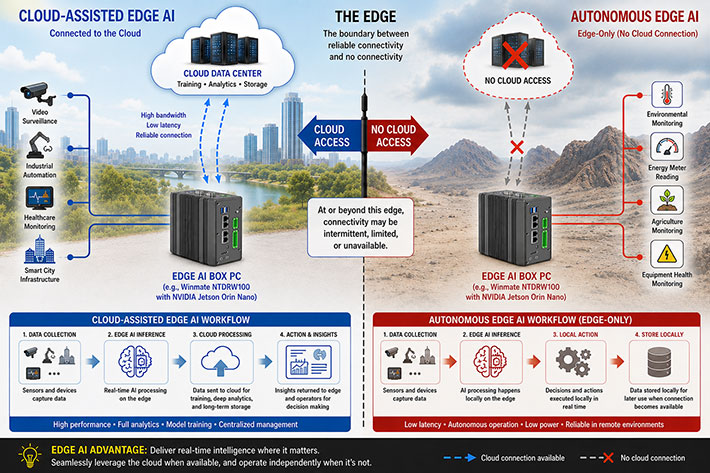
Conventional cloud-centric AI relies on fast, reliable communication with powerful remote servers that handle much of the processing. Without such access, AI workloads must be handled locally — which places greater demands on the hardware, but also enables immediate, self-contained operation.
That is where systems like the NTDRW100 come in. They are designed to perform this kind of processing directly at the edge, providing real-time analysis and decision-making without depending on constant connectivity.
In practical terms, an NTDRW100 can be installed in vehicles, remote installations, or industrial systems, continuously performing its assigned AI tasks whether or not it has wired or wireless access to the cloud.
A different kind of data processing
Now let's look at what makes "AI processing" different from the regular processing that all computers perform.
In essence, traditional computing is optimized for well-defined problems that are handled in a largely sequential manner — step by step, one operation following another. AI workloads, on the other hand, involve analyzing large amounts of often unstructured data, where tasks can be broken into many smaller operations that are processed in parallel.
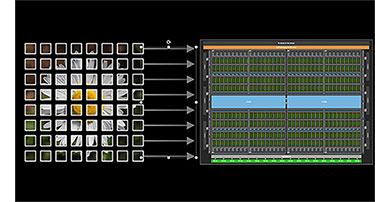 The difference is not just in speed, but in approach. Conventional computing typically aims for precise, deterministic results. AI processing, by contrast, focuses on rapid classification and decision-making, often based on probabilities rather than exact answers. The difference is not just in speed, but in approach. Conventional computing typically aims for precise, deterministic results. AI processing, by contrast, focuses on rapid classification and decision-making, often based on probabilities rather than exact answers.
Being confronted with different types of computing tasks is not new. Intel's hybrid processors, for example, combine high-performance cores for demanding workloads with efficiency cores that handle routine background tasks. One type provides maximum performance when needed, the other manages everyday processing efficiently.
AI workloads, however, go a step further. They require architectures specifically designed for massively parallel computation and for handling the matrix-based mathematics common in machine learning. To address this, Intel's recent Core Ultra processors include NPUs — Neural Processing Units — alongside their CPUs and integrated graphics.
Even so, these remain general-purpose processors with added AI capabilities. They are not fully dedicated AI architectures designed from the ground up for large-scale parallel processing.
Enter NVIDIA Jetson
And that's where NVIDIA comes in. The rise of artificial intelligence — and especially massively parallel processing — has made NVIDIA one of the most valuable companies in the world. The reason is straightforward: NVIDIA has been solving this kind of problem for decades in the context of high-performance graphics. Rendering complex graphics requires performing thousands of relatively simple calculations simultaneously — very much like modern AI workloads.
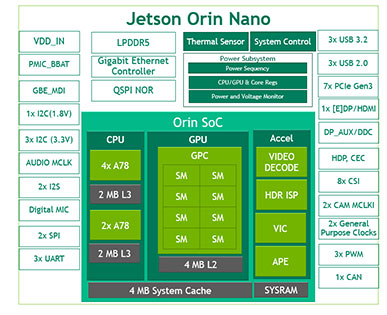 NVIDIA introduced its Jetson platform over a decade ago with the goal of bringing that kind of parallel processing capability to embedded systems for edge AI and robotics. The Jetson Orin Nano used in the Winmate NTDRW100 is part of that platform. NVIDIA introduced its Jetson platform over a decade ago with the goal of bringing that kind of parallel processing capability to embedded systems for edge AI and robotics. The Jetson Orin Nano used in the Winmate NTDRW100 is part of that platform.
So what is the Jetson Orin Nano? It is not just a processor, but a System-on-Module (SoM) — a compact, self-contained computing platform designed specifically for embedded AI applications.
The Jetson Orin Nano includes a 6-core ARM Cortex-A78AE CPU, a modern ARM processor designed for reliability in safety-critical applications. It is paired with 8GB of 128-bit LPDDR5 memory, and supports high-speed external NVMe storage. That covers the "conventional" side of the platform.
The other part is what makes the difference: an NVIDIA Ampere-architecture GPU with up to 1,024 CUDA cores and 32 Tensor cores. CUDA (Compute Unified Device Architecture) is NVIDIA's parallel computing platform, and the Tensor cores are specialized units optimized for the matrix operations that underpin most AI workloads.
Taken together, the Jetson Orin Nano combines a general-purpose ARM CPU with a powerful, highly specialized parallel processing engine designed specifically for AI inference.
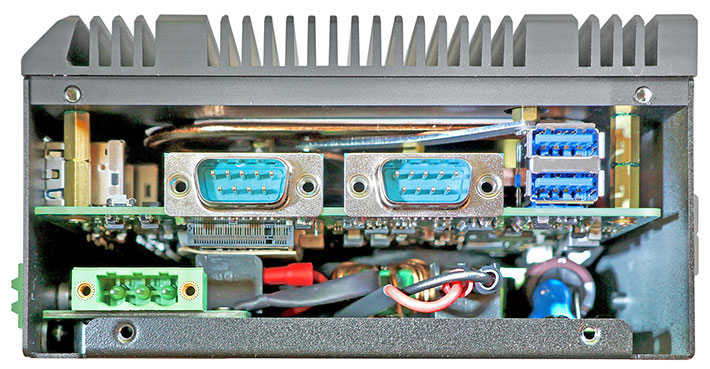
Below is a peek into the NTDRW100.
The software behind it
Hardware, however, is only part of the story. The rest is up to software and developers. Efficient programming, optimization, and the ability to fully utilize the available hardware resources can make a substantial difference in real-world performance.
As for software, the Winmate NTDRW100 runs Ubuntu Linux, based on Ubuntu 22.04 LTS with a Linux 5.15 kernel. On top of that sits NVIDIA's Jetson Linux platform (formerly known as Linux for Tegra), along with the JetPack software development kit that provides the tools and libraries needed to develop and deploy AI applications.
JetPack is a comprehensive environment that includes APIs, libraries, and development tools for GPU-accelerated computing and AI. It supports specialized frameworks such as Isaac for robotics, DeepStream for vision-based AI applications, and Riva for speech and conversational AI. Together, these components allow developers to build and deploy applications ranging from computer vision and video analytics to generative AI and real-time inference systems.
Beyond the core tools, NVIDIA maintains a large and active Jetson ecosystem. The company's developer site lists close to 200 community projects that showcase real-world implementations, concepts, and application ideas. These range from robotics and automation to smart infrastructure and industrial monitoring.
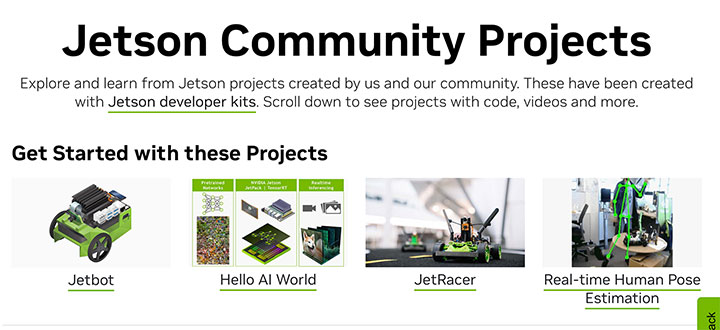
A number of industry examples illustrate how such systems are being used in practice. Applications include healthcare diagnostics, autonomous and semi-autonomous vehicles, smart transportation, retail analytics, industrial automation, safety monitoring, and energy management. These examples highlight the central idea behind the Jetson platform: bringing AI processing directly to the point where data is generated, rather than relying on remote cloud infrastructure.
For additional information, NVIDIA and Winmate both provide extensive documentation and application examples for edge AI deployments.
What all this means is that the NTDRW100 is not a general-purpose computer in the traditional sense, but a development and deployment platform for specialized AI workloads — one that depends as much on software integration and application design as it does on hardware capability.
In practice, working with the platform can require a level of familiarity with Linux and embedded systems that goes well beyond typical desktop computing. Even seemingly simple tasks, such as adding wireless connectivity via USB adapters, may require manual driver installation and troubleshooting. This reflects the embedded nature of the Jetson ecosystem, which is optimized for deployment within engineered solutions rather than general-purpose end-user operation.
Summary: the Winmate NTDRW100
 Now it becomes clear why the NTDRW100 is not like a standard Windows-based Box PC that you can use much like a desktop or laptop. It may look like a conventional industrial PC, but it is, in reality, a dedicated AI processing system built around the NVIDIA Jetson Orin Nano platform and running Linux. Now it becomes clear why the NTDRW100 is not like a standard Windows-based Box PC that you can use much like a desktop or laptop. It may look like a conventional industrial PC, but it is, in reality, a dedicated AI processing system built around the NVIDIA Jetson Orin Nano platform and running Linux.
And while the system uses Ubuntu, it is not comparable to a typical desktop Linux installation. The Jetson platform combines Ubuntu with NVIDIA-specific kernel, drivers, and development frameworks, and that can make even routine tasks more complex than expected. This is a platform intended for skilled developers building and deploying specialized AI solutions.
The target market for systems like the NTDRW100 consists of industrial and edge AI applications that require ruggedness, low-latency inference, and the ability to operate both with and without cloud connectivity. Winmate describes this as "AI-assisted analytics for real-time insights," and there are already numerous applications in manufacturing, healthcare, smart cities, transportation, and industrial automation.
The Winmate NTDRW100 is not a computer for general-purpose use. It is a compact, rugged AI engine designed to be built into systems that require real-time intelligence — applications that would have been impractical or impossible just a few years ago. -- Conrad H. Blickenstorfer, Ph.D., May 2026
|
Winmate NTDRW100 Specifications
|
| Added/changed |
Full review 05-2026
|
| Type |
DIN Rail Box PC
|
| Processor |
NVIDIA Jetson Orin Nano, up to 67 TOPS Super Mode (6-core ARM Cortex-A78AE)
|
| CPU speed |
Max turbo frequency of ARM cores up to 1.7GHz
|
| Module power/power mode |
15/25 watts
|
| Thermal |
Fanless passive cooling
|
| OS |
Ubuntu 22.04-based NVIDIA Jetson Linux with JetPack 6.2
|
| Graphics |
1024-core NVIDIA Ampere GPU running at 1020 MHz |
| Memory |
8GB LPDDR5 @ 2133 MHz on SOM
|
| Disk/drive |
M.2 2280 M-Key NVMe SSD 256GB/512GB/1TB/2TB
|
| Display size and resolution |
NA
|
| Digitizer/Pen |
NA
|
| Expansion slots |
1 x M.2 2230 E-Key slot (for Wi-Fi and Bluetooth)
1 x M.2 3042/3052 B-Key slot (for 4G/5G WWAN)
|
| Housing |
Steel and aluminum housing; DIN rail mount
|
| Temperature |
-4°F to 140°F (-20°C to +60°C)
|
| Humidity |
10 to 90% non-condensing |
| Ingress Protection |
NA |
| Vibration: Functional |
MIL-STD-810H Method 514.8 Procedure I |
| Shock |
MIL-STD-810H Method 516.8 Procedure I (optional) |
| Certification |
CE, FCC
|
| Size (inches) |
5.1 x 2.7 x 5.9 inches (130 x 68 x 150 mm) |
| Weight |
5.5 pounds (2.5 kg) |
| Power |
9V to 36V DC input; PoE PSE output follows IEEE 802.3at, up to 30W
|
| Wireless Communication |
optional via M.2 2230 E-Key slot or USB adapter, 1 x nano SIM Card slot (optional)
|
| Interface |
3 x USB 3.2 Gen2 (Type-A)
1 x USB 2.0 (Type A)
1 x USB 3.2 Gen2x1 Type-C for OTG
1 x isolated RS232/422/485 DB9
2 x isolated RS232/422/485 via 10 pin terminal block
1 x HDMI 2.0b (optional)
1 x 10/100/1000 Mbps Ethernet with PSE (up to 30 watts)
3 x 10/100/1000 Mbps Ethernet
1 x audio mic int
1 x audio line out
1 x isolated 9-36V DC 3-pin terminal block
1 x isolated 20 pin DIDO
|
| Price |
Inquire |
| Web page |
Winmate NTDRW100 web page
|
| Spec sheet |
Winmate NTDRW100 spec sheet |
| Warranty |
3-year limited warranty standard |
| Contact |
Winmate Headquarters
No. 18, Zhongxing South Street
Sanchong District, New Taipei City 241017
Taiwan (R.O.C.)
|
|
|